
Spare parts and repairs: A right in Europe
Europe has taken measures favouring a circular economy such as eco-design standards, availability of spare parts and the right to repair. France has always been a pioneer in Europe on the circular economy and strongly encourages repair rather than exchange of defective products. Here are the existing European and French regulations that encourage the repair of products.
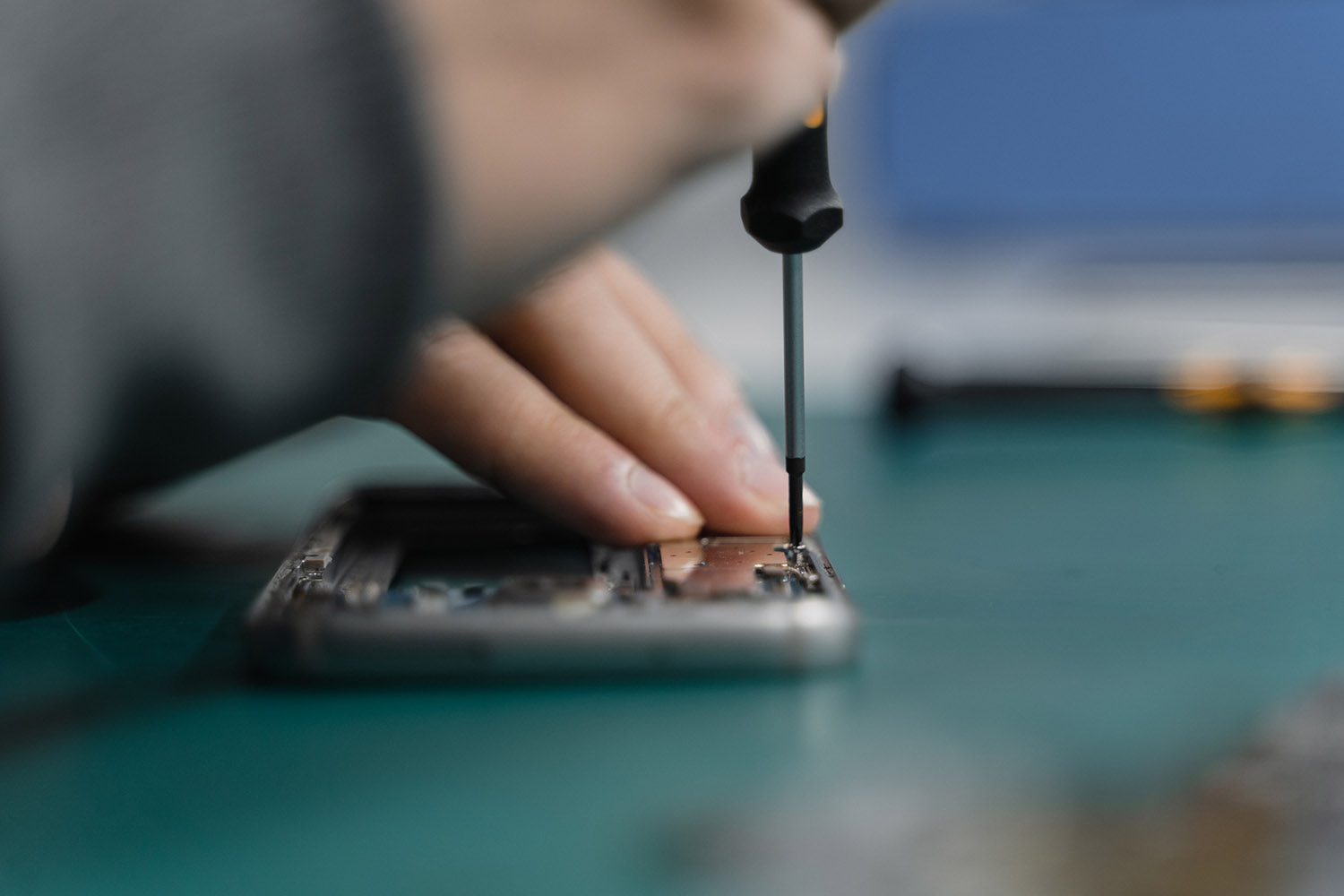
Manufacturers must provide spare parts
To ensure that spare parts are available within a reasonable period of time and at an attractive price, rules impose on manufacturers that:
- Spare parts for refrigeration devices (refrigerators, freezers, wine cellars, etc.) must be available for 7 years after purchase.
- Spare parts must be available for 10 years after the purchase of washing machines, dryers, and dishwashers.
- Manufacturers must assure the delivery of spare parts within a waiting period of 15 days.
- Manufacturers must provide to consumers a list of spare parts available on the internet.
- Manufacturers have the obligation to clearly explain through the documentation the defects that may occur, how to carry out repairs, and their cost.
- Manufacturers must guarantee that the parts of the appliance can be replaced with classic tools.
France, a European pioneer in the circular economy
Sellers must inform consumers about the availability or unavailability of spare parts. If they give no information, the spare parts are presumed to be unavailable. The manufacturer or importer has 15 days to supply the spare parts.
For certain electronic and electrical products, spare parts must be available for at least 5 years from the date they were placed on the market. When repairing electronic and electrical products, second-hand spare parts may be used. Brands are forbidden to use any technique, including via software, which makes it impossible for an appliance to be repaired or reconditioned by a repairer other than one approved by the brand. Any practice that limits a repairer’s access to spare parts, instructions for use, technical information or any other tool, equipment or software enabling the product to be repaired is prohibited.
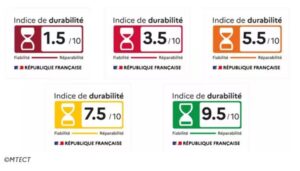
What is a durability index?
The durability index is a new tool that informs consumers about the relative durability of electric or electronic products they have purchased. It will help them evaluate the lifespan of their appliance.
Introduced in 2025, the durability index currently covers only 2 categories of products:
- Televisions since 2025
- Front and top load washing machines since 2025
In practical terms, this index involves a pictogram, consistent across products, marked with a score between one and ten and a colour ranging from dark red to green.
Example: A washing machine with a rating of 1.5 would be considered very unreliable and difficult to repair, whereas a rating of 9.5 would suggest a washing machine that will last over time.
This index is based primarily on 2 criteria:
- Reparability: this criterion mainly considers the accessibility of technical documentation, ease of dismantling, and the availability and price of replacement parts.
- Reliability: this criterion accounts for, among other things, resistance to stress and wear, ease of maintenance and servicing, as well as the existence of a commercial guarantee and a quality process.
Is the seller required to display this index?
The manufacturer assigns a rating from 1 to 10, which is then passed on to the seller, who must display it. Whether you buy it in a physical shop in France or on the internet, whether the website is French of foreign, as long as it is aimed at French consumers, the seller is required to display the durability index.
The index must be fixed to the product or its packaging, placed next to the price tag, in a visible, legible, and easily accessible manner. For purchases made in-store, the pictogram should be displayed on the shelf. For sales made online, it must be displayed on all web pages where the appliance can be purchased. It must be legible on the screen, in a font size equivalent to that of the price, without having to click to display it.
Manufacturers must also communicate the details of the durability index rating to the customer. If you ask for the detailed calculation grid to help you understand why an appliance has a good score, you should receive it, free of charge, electronically within five days.
The reparability index is still in place
For other household appliances and electronics (smartphones, laptop computers, electric lawnmowers, pressure washers, corded and cordless handheld and robotic vacuum cleaners), the reparability index still applies. This index is less developed than the durability index, as it only tells you about the ability to repair the concerned product. An extension of the durability index to these other products is likely, but has not yet been announced.
The French Ministry for Ecological Transition and ADEME have set up a website (in French), where you can find a professional who repairs, recycles, buys back products or offers any other solution to extend the useful life of objects. The website also offers practical advice on how to buy responsibly, tools and objects to share with neighbours, etc.
To encourage people to repair rather than exchange faulty products, France provides, for example, that your legal guarantee of conformity is suspended while your appliance is being repaired, or that you benefit from a 6-month extended guarantee if you opt to have your appliance repaired. It even provides for a 2-year warranty renewal if the seller replaces your appliance instead of repairing it as you requested.
Planned obsolescence is defined under French law as “the use of techniques by which the person responsible for placing a product on the market deliberately aims to reduce its lifespan in order to increase the replacement rate”.
The following are also prohibited in France:
- “any technique, including software, which aims to make it impossible to repair or recondition an appliance”;
- “any agreement or practice aimed at limiting a repair professional’s access to spare parts, instructions for use, technical information or any other instrument, equipment or software enabling products to be repaired”
To limit the planned obsolescence of devices, particularly smartphones, you should be informed of how long your device will be able to withstand successive updates.
To reduce the repair bill paid by consumers, France has introduced a repair bonus financed by the “polluter pays” scheme on 73 everyday electrical and electronic products: mobile phones, TVs, washing machines, ovens, cameras, speakers, computers, coffee machines, tools, etc.
Consumers therefore pay less to repair a broken product that is no longer under warranty (legal, commercial or insurance). It is the repairer who must take steps to recover the amount covered by the fund, the bonus is directly deducted from the consumer’s bill.
The amount of the bonus depends on the product and varies from 15 to 60 euros.
You can find out here which products are eligible and the amount of the repair bonus.
To find a certified repairer, visit the Qualirépar platform.
Want to give your clothes and shoes a second life? A repair bonus for textiles and footwear was introduced in France in 2023. Reimbursements range from 6 euros for an undone seam to 25 euros for the resoiling of a leather shoe.
Only repairs carried out by professionals with the “Refashion” label are eligible for reimbursement. The professionnal can repair several things on a piece of clothing, as long as the total amount doesn’t exceed 60% of the repair price.
You can check the list of eligible products and discounts and the amount of the repair bonus and find a certified repairer on the online map.
The right to repair in the European Union
The directive on the right to repair, which started to apply on 31 July 2026, provides for several measures to promote product repair in the European Union.
Within the legal guarantee
Any product repaired under warranty benefit from a one-year extended warranty. However, EU countries may implement more favourable conditions on the national level if they want to. In France, for example, the warranty is extended for two years if the seller replaces the product rather than repairing it.
Beyond the legal guarantee
- A right for consumers to claim repair to producers exists for a category of products that are technically repairable and affected by ecodesign measures (refrigerators, washing machines, televisions, dishwashers, etc.), as well as telephones and tablets.
- Manufacturers must offer to repair these products. You may demand that they repair your fridge or washing machine if it has broken down. However, repairs carried out outside the warranty period are not free of charge. They may be able to lend you a replacement appliance for the duration of the repair.
- An online platform will be set up in 2027 to enable you to connect with repairers and sellers of refurbished goods in your area, a seller of reconditioned products, or even local participative repair initiatives. Although France already has such a platform, other European countries have yet to set one up.
- Willing repairers may provide you with a European repair information form for all products covered by the right to repair. The aim is to provide a framework for repair quotations in terms of repair price, delays and conditions. The form would then be valid for a period of 30 days so that consumers can compare offers from different repairers.
- Manufacturers must provide you with spare parts and tools at a reasonable price. They may not use clauses or techniques that hinder repairs. Examples: preventing independent repairers from using second-hand or 3D printed spare parts, refusing to repair a product solely for economic reasons or because it has already been repaired by a third party, etc.
The right to repairs in the European countries
Many European countries are currently considering this subject of circular economy and spare parts. An overview of the rules in various European countries, thanks to the ECC-Net.
Since April 26, 2022, private individuals may apply for a repair voucher that covers up to 50 % of the repair costs of electronicequipment (e.g. smartphone, laptop, washing machine, e-bike) and/or up to 30 euros for obtaining an estimate (maximum total of 200 euros).
The repair voucher can be applied for at reparaturbonus.at and redeemed within 3 weeks upon payment of the invoice. The bonus can be redeemed as long as budget funds are available. The funding campaign runs until 2026. The repair bonus is financed with funds from the “Next Generation EU” financing and development fund made available by the European Union and comprises a total funding volume of 130 million euros until 2026.
Belgium has reduced its VAT tax rate to 6% for small repairs of bicycles, shoes, leather goods, clothing, and household linens.
Croatia has transposed the Eco-Design Directive, which requires the supply of spare parts within a certain period (see above).
The seller must ensure spare parts for technical products, motor vehicles and other vehicles during the commercial guarantee period.
There is no specific regulation regarding spare parts in the Finnish Consumer Protection Act. However, according to the Act, the product is defective when the product’s service life is shorter than what could reasonably be expected. If the trader is not able to provide necessary spare parts, the product is considered defective. In such a situation, the buyer may demand a reduction in the price that corresponds to the defect, or cancel the sale if the defect is not minor. Because the trader may be obliged to repair the product several years after the sale, this may encourage the trader to keep spare parts available for a relatively long time.
In principle the consumer is allowed to choose whether to have the goods repaired or replaced. On the other hand, if the defect is minor and easily repairable, the trader is usually allowed to fix it. The latter starting point emphasizes sustainable consumption.
Germany has transposed the Eco-Design Directive, which requires the supply of spare parts within a certain period (see above).
In addition, consumers must be informed at the time of purchase which defects can occur, whether and how the product can be repaired and what the costs are.
Traders have also obligations to recycle more and produce less waste and take back old electronic equipment under certain conditions. They can no longer destroy returns of products that are almost as good as new.
Core measures:
- The fitness for use of goods must be maintained (e.g. through careful handling, storage, transport, donation of the goods, reduced sale of the goods, sale before the expiry date, etc.).
- If the goods can no longer be used for their original purpose, other uses can also be considered
- If the goods can no longer be used, recycling is preferable to destruction (“cascade of use”).
- Already during the production of the goods, care must be taken to ensure that waste is reduced through production and use and that any waste can be recycled or disposed of in an environmentally sound manner (“product responsibility”).
So far, these are rather voluntary obligations.
The seller must ensure the supply of spare parts during the estimated lifetime of the product.
In Ireland, there is no obligation for the seller to inform the consumer about spare parts, but the law specifies that spare parts as well as adequate after-sale service must be provided by the seller for the period mentioned in the offer, description, or advertisement made by the seller.
The VAT tax rate for small repairs on bicycles, shoes, leather goods, clothing, and household linens has been reduced to 13,5%.
There is no obligation to inform consumers on the availability of spare parts, but the seller must inform the consumer if the goods are no longer produced.
Luxembourg applies a reduced VAT rate of 8% on small repairs on bicycles, shoes, leather goods, clothing, and household linens.
In Malta, if products purchased by the consumer need maintenance or replacement of parts, this replacement of parts and the appropriate repair service must be available within a reasonable waiting period after the delivery date.
Furthermore, Malta applies a reduced VAT rate of 5% for small repairs on bicycles, shoes, leather goods, clothing, and household linens.
Poland has implemented a right to repair since 1 April 2021 with an obligation of spare parts for 7 to 10 years, depending on the product.
Poland applies a reduced VAT rate of 8% on small repairs on bicycles, shoes, leather goods, clothing, and household linens.
The manufacturer has the obligation to provide spare parts needed for the repair of goods for 10 years from the date of the placing on the market of the last item.
Portugal applies a reduced VAT rate of 6% for small repairs on bicycles. A reduced VAT rates for repairs on shoes, leather goods, clothing and household linen is under discussion.
The manufacturer must assure the supply of replacement parts during the estimated lifespan of the product.
In Slovenia, at the moment of a contract’s conclusion, the seller must provide a specific guarantee for certain technical goods that provides instructions for assembly and use, and which commits the seller to repair defects free of charge during the guarantee period.
The manufacturer must also, in exchange for payment, repair products and supply spare parts for at least three years after the expiration of the guarantee period. This after-sale service is guaranteed by the manufacturer itself or a third party.
Finally, Slovenia applies a reduced VAT rate of 9,5% on small repairs on bicycles, shoes, leather goods, clothing, and household linens.
Manufacturers are obliged to have parts to repair their products for 10 years after the product is no longer manufactured. They also have to provide a proper technical service during 10 years.
Sweden has reduced the VAT rate of 25% to 12% for repairs services for bicycles, shoes, leather goods, clothing and household linen.
Craftsmen are allowed to offer repairs on large electric appliances at prices up to 50% less expensive than the actual cost – the difference is paid by the state.
A tax deduction, the so-called “RUT- deduction”, applies to certain services within the households. The RUT-deduction means a tax reduction of 50 % of the labor cost for the service. Services covered are for example repairing clothes, curtains, bedding and removable sofa upholstery. IT services in the consumer’s home are also covered, e.g. to repair, install and maintain computers, tablets, game consoles, televisions and smart phones, as well as updating and installing operating systems and computer programs.
The Netherlands have reduced their VAT rate to 9% for small repairs on bicycles, shoes, leather goods, clothing, and household linens.
You might be interested in
Funded by the European Union. Views and opinions expressed are however those of the author(s) only and do not necessarily reflect those of the European Union or the European Innovation Council and Small and Medium-sized Enterprises Executive Agency (EISMEA). Neither the European Union nor the granting authority can be held responsible for them.
Was this article helpful?

